
Industrial Tunnel Furnaces: How They Work and Why Manufacturers Use Them
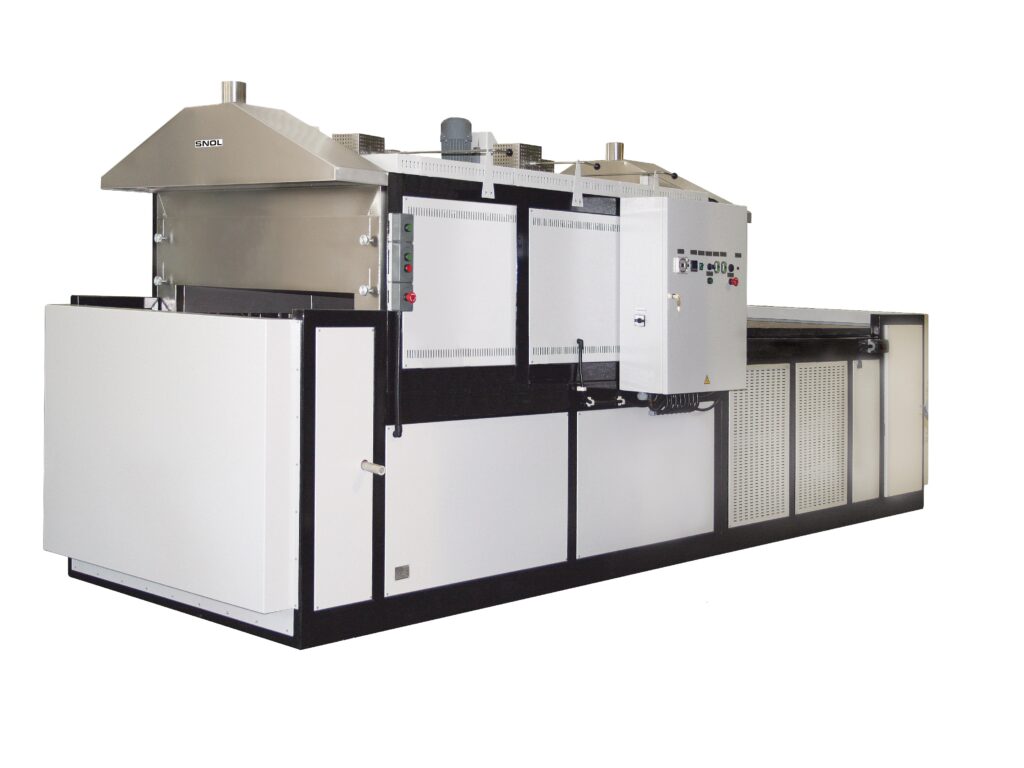
An industrial tunnel furnace is a long, continuous heating chamber where products move through on a conveyor or belt while passing through different temperature zones — heating, soaking, and cooling — without ever stopping the process. Instead of loading a batch, closing the door, and waiting for a full cycle to finish, a tunnel furnace lets parts flow in one end and come out fully treated at the other. That’s why they’re also called conveyor-type furnaces, and why they’re a favorite in high-volume metal, ceramics, and electronics production.
If you’ve ever wondered how a factory manages to heat-treat thousands of identical parts a day with consistent results, this is usually the answer. Below, we’ll break down how tunnel furnaces work, where they’re used, and what to consider before choosing one — including how SNOL’s conveyor-type furnaces fit into that picture.
How Does an Industrial Tunnel Furnace Work?
A tunnel furnace works by moving products through a series of connected heating zones on a conveyor, mesh belt, or roller system, rather than heating one closed chamber all at once. Each zone can be set to a different temperature, so a single part might pass through a preheat zone, a high-temperature zone, and a controlled cooling zone in one uninterrupted run.
This continuous-flow design is what separates a tunnel furnace from a standard batch or chamber furnace. In a chamber furnace, you load parts, run a full heating and cooling cycle, then unload — one batch at a time. A tunnel furnace instead keeps the line moving, which dramatically increases throughput for repetitive production tasks like:
- Metal component curing after washing or coating
- Continuous annealing or stress relieving
- Drying and curing of coatings, paints, or enamels
- Firing ceramics or glazes on a production scale
- Thermal processing in electronics and automotive parts manufacturing
Heating is usually electric, using resistance elements positioned along the tunnel walls, roof, or floor to keep temperature distribution even from one end to the other. Sensors placed throughout the tunnel constantly track internal temperature, feeding data back to a digital controller that adjusts heating output in real time. This is the same principle behind SNOL’s broader range of industrial furnaces, where uniform heat distribution and durable insulation are treated as non-negotiable design requirements.
Tunnel Furnace vs. Batch Furnace: Which One Do You Need?
The short answer: tunnel furnaces suit high-volume, repetitive processes, while batch furnaces suit lower volumes or parts that need custom cycles. If your production line runs the same part, at the same temperature profile, thousands of times a week, a tunnel furnace removes the loading/unloading downtime that batch furnaces require between cycles.
On the other hand, if you’re treating small batches of varied parts, or you need flexibility to change temperature programs frequently, a chamber or muffle furnace may be more practical — and often more cost-effective. SNOL’s hardening furnaces are a good example of this batch-oriented approach, offering box-type and laboratory configurations for exactly that kind of flexible, lower-volume work.
What Industries Rely on Tunnel Furnaces?
Tunnel furnaces are most common wherever consistency and volume both matter. That includes metalworking (curing, drying, and stress relieving after surface treatment), automotive component manufacturing, ceramics and glass production, electronics assembly, and food or pharmaceutical processing where continuous drying is required. SNOL’s own conveyor-type systems, for instance, are frequently applied for metal product curing right after a washing stage — a step that needs to happen fast, evenly, and without interrupting the production flow.
What to Consider Before Choosing a Tunnel Furnace
Four factors usually decide whether a tunnel furnace design will work for your process:
- Maximum temperature required — different materials and treatments call for different heat ceilings.
- Throughput — how many parts per hour need to move through the line.
- Zone control — whether the process needs distinct heating, soaking, and cooling stages.
- Footprint — tunnel furnaces are long by design, so floor space and line layout matter early on.
Because these variables differ so much between industries, most manufacturers work with a supplier that offers customised solutions rather than a fixed catalog model. That’s typically how tunnel and conveyor furnace projects get built — engineered around the specific part, material, and line speed rather than picked off a shelf.
Frequently Asked Questions
1. What is an industrial tunnel furnace used for?
It’s used for continuous heat treatment of parts moving on a conveyor — curing, drying, annealing, or firing — instead of processing one closed batch at a time. This suits high-volume manufacturing lines in metalworking, ceramics, and automotive production.
2. How is a tunnel furnace different from a conveyor oven?
Both move products through zones on a belt, but furnaces generally reach much higher temperatures than ovens. Ovens typically handle drying or curing under a few hundred degrees Celsius; furnaces are built for heat treatment at higher, more demanding temperatures.
3. Can tunnel furnaces run multiple temperature zones at once?
Yes. Tunnel furnaces are built with separate heating, soaking, and cooling sections along the same conveyor path, each independently controlled, so a part can experience a full thermal profile in one continuous pass.
4. What temperature can an industrial tunnel furnace reach?
It depends on the design and heating elements used, but industrial electric furnaces commonly operate up to 1300°C, with some specialized models reaching higher. The right maximum depends on the material and process involved.
5. Are tunnel furnaces energy efficient?
Well-insulated tunnel furnaces with modern digital controllers can be quite energy efficient, since heat isn’t lost through repeated door openings like in batch systems. Continuous operation also avoids the energy spent reheating an empty chamber after every cycle.
6. What industries use conveyor-type furnaces most?
Metal component curing, automotive parts, ceramics, electronics, and coatings/painting lines are the most common users, largely because these industries need consistent, repeatable thermal results at scale.
7. Can a tunnel furnace be customized for a specific product?
Yes, and in practice most industrial tunnel furnace projects are custom-engineered around the part’s size, required temperature, and line speed rather than bought as a standard off-the-shelf unit.
8. What’s the difference between a tunnel furnace and a chamber furnace?
A chamber furnace processes one batch at a time inside a closed space, while a tunnel furnace moves parts continuously through multiple zones. Chamber furnaces suit flexible, lower-volume work; tunnel furnaces suit steady, high-volume lines.
9. How do sensors keep temperature stable inside a tunnel furnace?
Temperature sensors placed throughout the tunnel constantly feed data to a digital controller, which adjusts heating elements in real time to keep each zone within its programmed range, even as parts continuously move through.
10. Who manufactures industrial tunnel and conveyor furnaces?
Several specialized manufacturers build these systems, including European heat-treatment companies like SNOL, which designs conveyor-type furnaces and other industrial furnace lines certified to ISO 9001 quality standards.
Talk to a Heat Treatment Specialist
Every production line has its own throughput, footprint, and temperature requirements, so the best next step is usually a direct conversation with an engineer rather than picking a model off a spec sheet. You can reach SNOL’s team directly through their industrial solutions page to discuss a tunnel or conveyor furnace built around your process.
Customized for your hot inovations
Innovative custom solutions and professional support for your needs in heat treatment processes.
Learn more