
Custom Thermal Processing Equipment Pricing: What Drives the Cost
Custom Thermal Processing Equipment Pricing: What Drives the Cost Short answer: Custom furnaces and ovens have no list price; each is quoted per project. Seven factors set the price: chamber volume, maximum temperature, heating power, loading system, control and documentation, compliance requirements, and materials. SNOL customized solutions range from a 290 L, 600°C furnace to a 27,000 L industrial oven, and every request receives a commercial offer with price, production and delivery terms.

The 7 factors that set the price
- Chamber volume. More volume means more steel, insulation and heating elements. SNOL builds chambers up to 75 m³.
- Maximum temperature. A 1100°C furnace needs different elements and thicker insulation than a 250°C oven of the same size.
- Heating power. Power follows volume and temperature, and it also decides your electrical connection cost.
- Loading system. Trolleys, removable hearths, conveyors, lifting gear and quench tanks add mechanical engineering.
- Control and documentation. Multi-zone control, extra thermocouples for uniformity checks and data logging add cost but cut scrap.
- Compliance. AMS2750G and CQI-9 pyrometry, or explosion-proof (EX) electrics, require extra components and testing.
- Materials. Stainless-steel chambers, special coatings or atmosphere tightness raise material cost.
Real SNOL custom builds: size, temperature and power
These completed projects show how volume and temperature drive heating power, the main cost signal in any quote.
| Project | Volume (L) | Tmax (°C) | Power (kW) |
|---|---|---|---|
| SNOL 290/600 | 290 | 600 | 20 |
| SNOL 360/600 | 360 | 600 | 12 |
| SNOL 576/800 | 576 | 800 | 60 |
| SNOL 600/250 | 600 | 250 | 14 |
| SNOL 1000/600GL | 1,000 | 600 | 25 |
| SNOL 2300/1100 | 2,300 | 1100 | 140 |
| SNOL 7392/450 | 7,392 | 450 | 60 |
| SNOL 12800/650 | 12,800 | 650 | 120 |
| SNOL 27000/400 | 27,000 | 400 | 140 |
Note the SNOL 2300/1100: at 2,300 L it needs the same 140 kW as the 27,000 L oven, because it runs at 1100°C. Temperature often costs more than size. Data from SNOL case studies.
Options that add cost, and why they can pay back
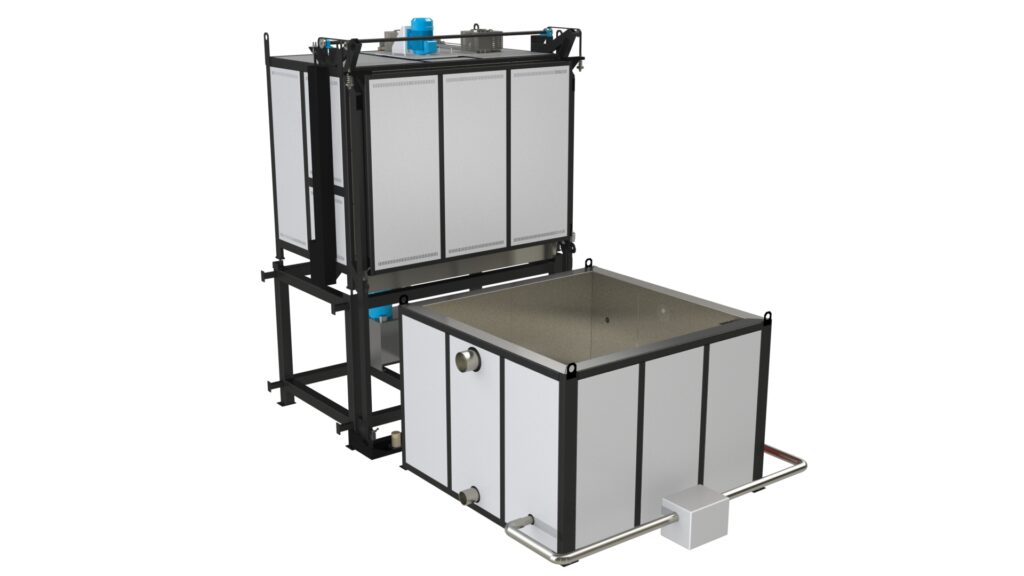
Automated handling
The SNOL hardening line adds a quenching tank for oil, water or polymer, with pneumatic unloading and vertical load transfer. It costs more than a single furnace but removes manual handling between heating and quenching.
Explosion-proof design
The SNOL EX chamber furnace dries varnished motor stators at up to 200°C in a 1.5 m³ stainless-steel chamber. EX-rated electrics, a control panel in a separate safe room and adjustable airflow raise the price but make the process legal and safe.
Conveyor and continuous systems
Conveyor-type furnaces cost more than batch units but suit high, steady throughput.
How to get an accurate quote fast
A complete brief removes rounds of questions and gives a firmer price. Send these details:
- Process type and target temperature, plus the maximum temperature needed
- Largest load size, weight and number of parts per batch
- Required heating, holding and cooling times
- Loading method: shelf, trolley, forklift, crane or conveyor
- Available power supply and floor space
- Standards to meet, such as AMS2750G, CQI-9 or EX/ATEX
Send the brief through the SNOL contact form or to sales@snoltherm.com.
Custom vs standard: which is cheaper?
A standard model is almost always cheaper and faster when it fits. SNOL makes 150+ standard models, keeps 200+ units in stock and ships in about 4 weeks (Why SNOL). Check the industrial chamber furnaces, removable-hearth ovens and walk-in ovens first; go custom when size, handling or compliance rule them out.
Frequently asked questions
How much does a custom industrial furnace cost?
There is no fixed price list. Price depends on chamber volume, maximum temperature, heating power, loading system, controls, compliance and materials. SNOL quotes each project individually.
What has the biggest effect on custom furnace price?
Chamber size and maximum temperature together, because they set heating power, insulation and steel structure. SNOL’s 27,000 L oven at 400°C needs 140 kW, while a 600 L oven at 250°C needs 14 kW.
Is a custom furnace more expensive than a standard model?
Usually yes, because it needs engineering time. If a standard model with options fits, it is the cheaper and faster route.
How do I get an accurate quote?
Send process temperature, load size and weight, throughput, cycle times, loading method, power supply and required standards.
Sources
Customized for your hot inovations
Innovative custom solutions and professional support for your needs in heat treatment processes.
Learn more